


AlertCenter + AFS: Your Collective Tool for Fighting Deposit Fraud
Overview
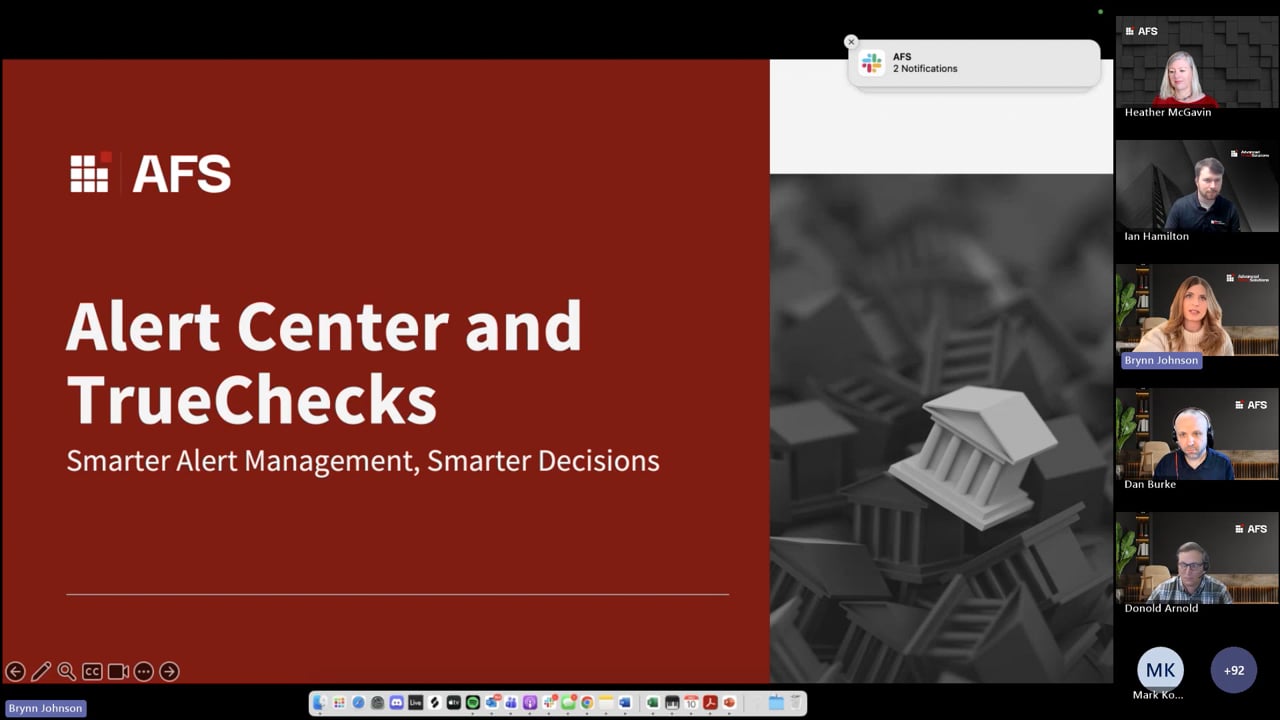
This session brings together the AFS TrueChecks® team and Jack Henry’s AlertCenter® users for a practical, behind-the-scenes look at how to fight deposit fraud as a collective. The panel explains how the TrueChecks consortium database is built from FI contributions, why contribution files matter, and how alert optimization can dramatically cut noise while surfacing the most important risks. You’ll see how alert settings, duplicate detection, and reporting tools work in the TrueChecks portal and in AlertCenter, plus what’s coming next for reporting, Treasury checks, and payee name verification.
What you’ll learn
- How the TrueChecks® consortium database is built from FI contributions and partner item processors
- Which contribution files matter most (returns, account status, stop-payment, and action-taken) and how they feed fraud intelligence
- How to use alert optimization to cut false positives, speed investigations, and reduce teller alert fatigue
- How new tools like multi-criteria optimizations, allow/block lists, 30-day lookback, and audit logs help fine-tune alerts
- How to schedule free, unlimited optimization and performance analytics sessions with the AFS support team
- How duplicate detection works, when to adjust Grace Periods, and how to manage internal duplicate noise without losing real fraud signals
- How to use TrueChecks reports and dashboards to audit user searches, track recommendations, and support exam and audit requests
- What’s coming next in reporting (Power BI engine, custom/ad hoc reports, scheduled delivery, and more user-friendly filtering)
- How upcoming Treasury check enhancements and payee-name verification will appear in AlertCenter
Key moments
- Welcome, audio/visual check, chat/Q&A directions, and confirmation that slides and recording will be shared
- Introduction of the AFS support and technical team and how they partner with FIs day-to-day
- Overview of how the TrueChecks database is built from FI contribution files and item processor partners
- Deep dive on contribution files: on-us/off-us returns, account status, stop-payment, and action-taken
- Explanation of how contribution data feeds TrueChecks recommendations and improves protection across the consortium
- Alert optimization section: why tuning matters, how it reduces false positives, and how it saves staff time
- Demo of the alert optimization screen: multi-criteria settings, allow/block lists, and 30-day lookback
- Walkthrough of suggested optimizations, how they’re curated from trends across the AFS customer base, and how to enable/disable them
- Review of optimization audit logs and how to track changes and ownership over time
- Q&A: where alert optimization lives (AFS portal), how to request a custom analysis, and how the scheduling widget works
- Administration settings overview: max API results, duplicate detection behavior, Grace Periods, and when to adjust them
- Discussion of internal duplicate scenarios (teller rescans) vs. true duplicate fraud and why Grace Periods should stay tight
- Reporting demo: search detail reports, user-level auditing, and dashboard widgets for monitoring recommendation trends
- Preview of the reporting roadmap: Power BI engine, ad hoc/custom reports, scheduled report delivery, and easier column/filter controls
- Q&A on ROI timelines, teller-channel performance, and how optimization work can dramatically reduce alert volume while improving accuracy
- Discussion of product feedback channels: how to submit enhancement ideas (e.g., channel-specific thresholds) to AFS and Jack Henry
- Update from Jack Henry on new Treasury check payee-name verification coming in AlertCenter release 2024.1
-
Closing remarks, recap of support center resources, and reminder to watch inboxes for slides, recording, and follow-up links
Resources
- AFS Help & Support Center — Knowledge base, on-demand webinars, and scheduling for alert optimization and performance analytics meetings.
- Email: support@advancedfraudsolutions.com — Contact the AFS support team for contribution file setup, optimization requests, and product questions.